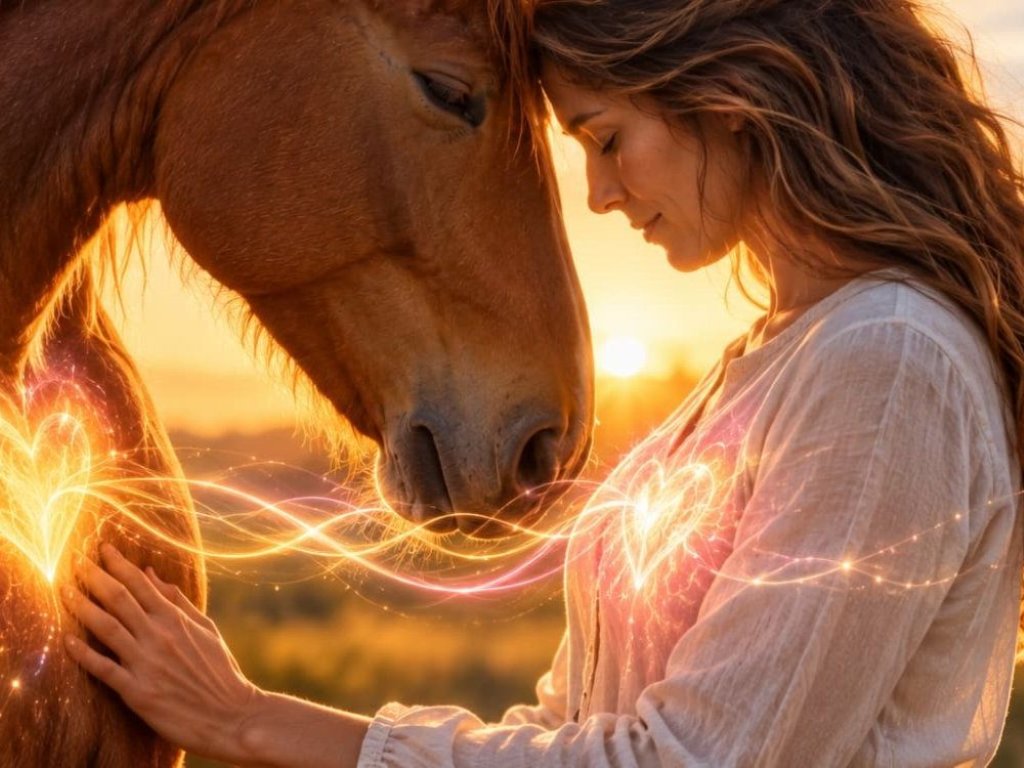
What Happens Between a Horse and a Human? The HeartMath Connection
If you’ve ever stood quietly beside a horse and felt yourself settle without really knowing why, you’re not alone.
Your breathing slows. Your shoulders drop. The noise in your head gets a little quieter.
And sometimes, the horse seems to shift right along with you.
We often hear people describe it as “energy” or say that horses can “feel what we’re feeling.” And while there is still a lot to learn about exactly what happens between horses and humans, research into the heart, nervous system and something called heart coherence gives us an interesting way to understand part of that connection.
Your Heart Is Doing More Than Pumping Blood
HeartMath research has spent decades studying the relationship between the heart, brain, emotions and nervous system.
One of the concepts they study is heart rate variability, or HRV — the natural variation in the time between each heartbeat.
When we are stressed, frustrated, anxious or overwhelmed, the patterns in our heart rhythm can become more irregular. When we experience emotions such as appreciation, calm or compassion, those patterns can become more ordered and stable.
HeartMath refers to this more synchronized physiological state as coherence.
And here’s where horses make this really interesting.
Horses Are Incredibly Sensitive to What Is Happening Around Them
A horse is a prey animal.
Their survival has always depended on noticing subtle changes in their environment — movement, posture, tension, breathing and behaviour.
Long before we say, “I’m nervous,” our body may already be showing it.
Our breathing changes.
Our muscles tighten.
Our movements change.
Our heart and nervous system respond.
And the horse is paying attention.
That is one of the reasons working with horses can be so powerful. We can tell another person, “I’m fine.”
The horse doesn’t care about the words.
They respond to what is actually happening in front of them.
Can Horses and Humans Actually Synchronize?
Research into horse-human interactions has explored whether physiological patterns, including heart rate and heart rate variability, can become connected or synchronized during certain interactions.
Some studies have found interesting associations between the physiological responses of horses and humans, although this is an emerging area of research and scientists are still working to understand exactly how and why these patterns occur.
That distinction is important.
We don't need to claim that a horse is magically reading someone's heart.
What we do know is that horses are remarkably responsive to subtle changes in human behaviour and physiology.
And that creates an incredible opportunity for learning.
The Horse Gives Us Feedback We Can't Talk Our Way Around
Imagine walking into an arena feeling frustrated.
You smile.
You say you're good.
You tell yourself you're calm.
But your body is saying something completely different.
The horse may hesitate.
Move away.
Become more alert.
Or simply respond differently than you expected.
Then something changes.
You stop trying so hard. You breathe. You become more aware of your body. Your movements become clearer and your intention becomes more consistent.
And the horse responds differently.
That moment can be incredibly powerful because the participant didn't need someone standing there saying:
“You're stressed.”
The horse helped them experience the difference for themselves.
This Is Why the Horse Is the Teacher
In Equine Assisted Learning, we're not asking the horse to diagnose someone, fix them or provide therapy.
We're creating structured opportunities where people can learn through experience.
The horse provides immediate, honest feedback.
If our communication isn't clear, we see it.
If we're pushing when we think we're leading, we see it.
If our body is saying something different from our words, we may see that too.
And when we change something within ourselves and suddenly get a different response from the horse?
That's where the learning becomes real.
Because now we're not just talking about communication, leadership, trust, boundaries or emotional awareness.
We're experiencing it.
Maybe That's Why Horses Feel Different
There's still much more to learn about the science of the horse-human connection, and HeartMath and HRV research are only pieces of a much bigger picture.
But perhaps they help explain something horse people have understood for a very long time:
Horses notice things we often overlook in ourselves.
They invite us to become more aware.
More present.
More intentional.
More congruent between what we're feeling, what we're communicating and what we're actually doing.
And when a 1,200-pound animal responds differently because we changed something?
That's a lesson that's pretty hard to forget.
That is the beauty of Equine Assisted Learning.
The horse doesn't need to tell us the answer.
They give us the opportunity to discover it for ourselves.