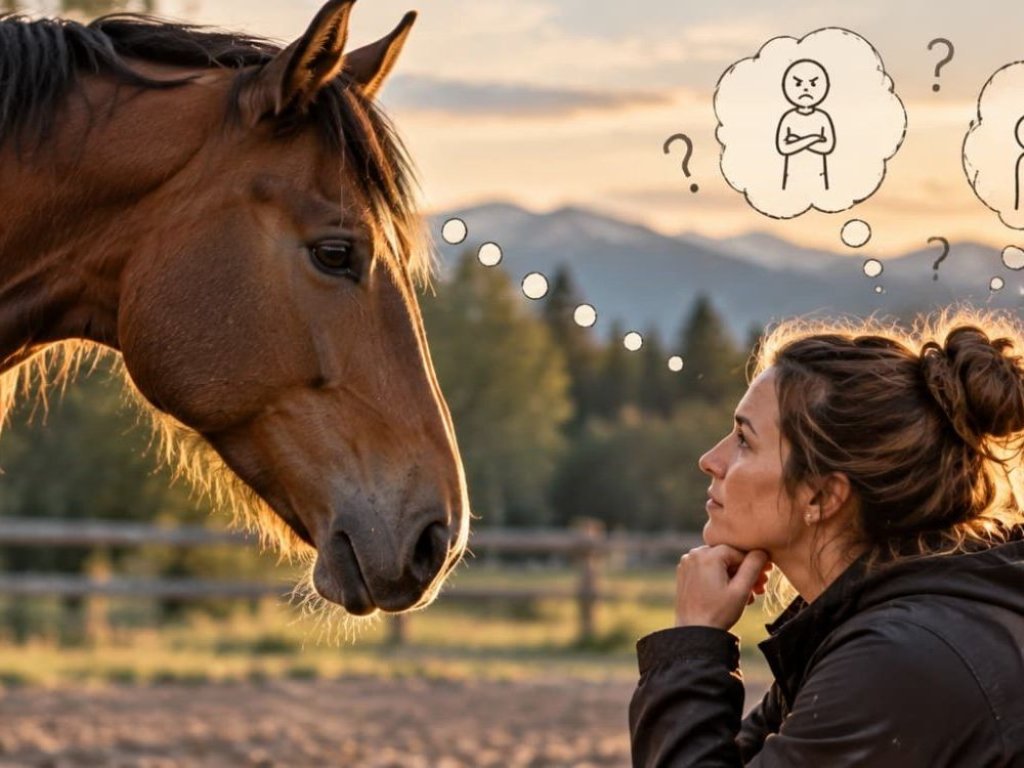
Are We Listening to the Horse… or Just Putting Human Meaning on What They Do?
One of the most important things we can learn when working with horses is also one of the hardest:
Stop assuming the horse thinks like we do.
We love horses. We connect deeply with them. We give them personalities, tell stories about what they’re thinking and sometimes swear we know exactly how they’re feeling.
“He’s being stubborn.”
“She’s mad at me.”
“He doesn’t like that person.”
“She’s just being dramatic.”
“He knows exactly what he’s doing.”
But does he?
Or are we putting our own human emotions, intentions and explanations onto behaviour that may actually mean something completely different in the horse’s world?
Horses Are Horses. And That’s What Makes Them Incredible.
Horses experience and respond to the world differently than humans do.
They are highly sensitive animals that pay incredible attention to movement, pressure, energy, body position, changes in their environment and the behaviour of those around them.
Their communication is often subtle.
An ear changes direction.
The head lifts.
The body becomes still.
A foot moves.
The muzzle tightens.
The horse turns away.
The distance between you changes.
They lick and chew.
They blink.
They soften.
They move closer.
All of it can give us information.
The problem begins when we immediately decide what that information means based on our human interpretation.
Instead of observing, we start creating a story.
Observation Before Interpretation
There is a big difference between saying:
“The horse moved away when I stepped toward him.”
and saying:
“The horse moved away because he doesn’t like me.”
The first is an observation.
The second is an interpretation.
Maybe trust is involved. Maybe it isn’t.
Perhaps your body position created pressure. Perhaps the horse was responding to something happening behind you. Perhaps you moved into their space too quickly. Perhaps they simply wanted more distance at that moment.
When we jump straight to an interpretation, we risk missing what the horse is actually communicating.
That is why learning horse communication is so important.
We want to become curious before we become certain.
Humanizing Horses Can Cause Us to Miss Their Boundaries
There is another important reason to understand this distinction: the welfare of the horse.
Humanizing horse behaviour can sometimes cause us to overlook very clear communication.
We might think:
“Oh, he loves hugs.”
“She loves when everyone pets her.”
“He’s just being grumpy.”
“He needs to learn that he can’t get away with that.”
But what is the horse actually saying?
If a horse repeatedly moves away, turns their head, changes their body position, becomes tense or attempts to create distance, we need to notice that communication rather than overriding it because we have already decided what the horse should be feeling.
Honouring the horse means allowing their communication to matter.
Sometimes the answer is yes.
Sometimes the answer is no.
Sometimes it is, “I need a little more space.”
And sometimes it is, “I’m not comfortable with what is happening right now.”
The horse should be allowed to have a voice in the interaction.
This Is Especially Important in Equine Assisted Learning
In Equine Assisted Learning, we often say:
The horse is the teacher.
But for the horse to truly be the teacher, we have to allow the horse to speak their own language.
If a facilitator immediately interprets everything the horse does for the participant, we can unintentionally put our own story into the experience.
“The horse walked away because you’re not confident.”
“The horse came to you because you finally trusted yourself.”
“The horse won’t move because you aren't being a strong enough leader.”
Those statements might sound powerful, but unless we can actually know that to be true, we are assigning human meaning to the horse’s behaviour.
There is a much more powerful approach.
Ask.
“What did you notice?”
“What changed?”
“What happened when you changed your position?”
“What did the horse do when you became quieter?”
“What do you think the horse might be communicating?”
“What could you try differently?”
Now the participant gets to observe, experiment, learn and make their own connection.
And the horse gets to remain a horse rather than becoming a character in a story we created for them.
Learn the Language Before You Translate It
Imagine trying to have a conversation with someone who speaks a completely different language, but instead of learning their language, you simply decide what everything they do must mean.
You probably wouldn’t understand them very well.
Yet we can do exactly that with horses.
Learning about equine communication gives us another option.
We can learn how horses use space. How they create and release pressure. How they communicate through movement. How they establish boundaries. How subtle changes in posture can matter. How quickly they notice changes in us that we may not even realize we are making.
The more we understand their language, the less we need to invent one for them.
Curiosity Changes Everything
Perhaps one of the greatest lessons horses can teach us is to stop assuming we already know.
Instead of:
“He’s stubborn.”
Try:
“What is he communicating?”
Instead of:
“She doesn't like me.”
Try:
“What changed between us?”
Instead of:
“He’s refusing.”
Try:
“What might I be missing?”
That shift is enormous.
Because when we stop trying to make the horse fit into our human understanding of the world, we can start learning to understand theirs.
And that is where some of the most powerful learning happens.
Not because we made the horse more human.
But because we finally allowed the horse to be a horse.
The horse is communicating all the time. Our job isn’t to decide what they’re saying before we listen. Our job is to learn their language well enough to hear them.